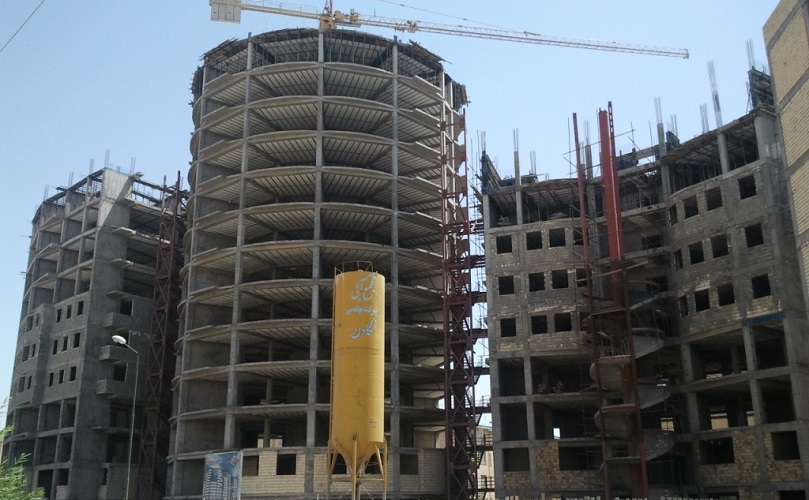
Concrete additives: are materials that change the properties of fresh concrete.
U stud: a type of profile that is mainly used in the construction of windbreaks, bridges, etc.
Rebar: a type of profile with a round cross-section and in a simple and ribbed form is used in reinforced concrete works and restraints.
Belt: with square, rectangular sections and is used to make doors, guards and patches in the building.
Wood: which in the old days was used for the sole of the door and for making doors and windows, and now for making doors and making molds.
Metal board: It is used in building decoration, making doors, sofas and concrete boxes.
Parquet: A process of wood that is used for building floor carpets.
Safety glass: a type of glass with a minimum thickness of 31 mm that does not shatter when broken.
Glass: Silica material is used to transmit light and prevent energy loss.
Batane: a type of paste that is mainly used in glass.
Bitumen: a type of petroleum product used in building insulation.
Flower straw coating: a type of mortar used to insulate the building.
Cement tile: a type of mosaic whose mortar is carefully made and vibrated.
Rabbits: It is a type of net to hold the coating in sections with a non-stick and polished surface.
Light concrete: a type of concrete in which aluminum powder and pumice are added for the purpose of sound and non-structural insulation.
Siporex: Gypsum bricks used to build a partition wall or light roof.
Gypsum panel: prefabricated gypsum mortar is used for isolation and thermal sound insulation.
Fiber concrete: a mixture of ordinary concrete with the addition of steel fibers, which spreads uniformly in concrete and increases the compressive strength of concrete in its own way, and is used in road construction and landscaping.
Blanket insulation: 311 mm thick rock wool, glass wool and cork insulation is used for thermal insulation.
Mehre concrete: concrete is used for leveling and cleaning the foundation floor and its grade is 351 kg.
Lime mortar: a mortar made of lime, soil, stone grains and water is used in foundations and flooring.
Chinese chair: stacking several rows of bricks on the foundation creates a height difference between the internal and external surfaces, which is called a chair.
Chetai: a type of sack used in insulation along with bitumen.
Isogam: coated bitumen sheets with layers of glass wool or synthetic fibers.
Barsang: The amount of protrusion of the surface of the stone in relation to the weight of the stone is called.
Gabion: Walls that are made of stone have nets around them for more resistance and uniformity.
Clay brick: Clay is made in perforated molds by moving it through the kiln for separation.
Industrial putty plaster: It is used to connect prefabricated plasterboards.
Door sill: a one-piece beam made of concrete, wood, iron, which is installed on top of the door.
Concrete putter: The concrete door sole is made in a certain way with rebar.
Support: A rebar that is used to withstand shear force.
Frame: The frame on which the door hinges and opens and closes.
Threshold: The bottom of the frame that is placed above the floor.
Shamseh: rectangular cans, the back of which is filled with plaster.
Ramp: the oldest and simplest means of communication between two uneven surfaces.
Elevator: A means of communication between floors in tall buildings, which is moved by a motor.
Sergir: a place at the entrance of the parking lot with a maximum height of 351 cm.
Floor of the stairs: the upper surface of the stairs is where the foot is placed.
Staircase: a vertical piece that is located between two consecutive floors.
Stair face: The side surface of the stairs is called the face.
Stair width: The distance between stairs is called stair width.
Footstep: It is a place where a person steps after walking a row of stairs.
Stair Bumps: The rungs used to prevent falls and the resulting hazards.
Step lip: The protrusion of the bottom of the step from the forehead is called the step lip.
Stair path line: The line indicating the staircase path is called the stair path line.
Step sword: The beam under the step is called a sword.
Escape stairs: Bridges that are installed outside the building, to be used in case of danger.
Roof: It is a cover to prevent the penetration of natural factors into the building.
Pakar: The location of the roof on the wall in the arch is called pakar.
Percussive arch: building a roof between two beams and laying bricks with impact on plaster and soil mortar.
Water sink: immersing the brick in water in order to catch its dust.
Coring: with different mortars, strips of 31 cm width are created in one direction at a certain distance, which are called corms.
Truss: A set of straight bars that are hinged together to form a triangular grid.
Iranit: Corrugated sheets made of cement, which is the most common roof covering of factories and warehouses.
Crepe: The means of connecting corrugated sheets (Iranite) to the sheets is called crepe.
False ceiling: The non-load-bearing covering that is under the main ceiling.
Piling: It is a wooden or metal rod that is placed on the body of the pit or the wall of the adjacent building in order to prevent the walls or soil from falling into the pit.
Pay: The set of parts of the structure and the soil in contact with it through which the load is transferred between the structure and the ground.
The root of the Chinese chair: the width of the chair on each side of the load-bearing wall is considered to be between 5 and 31 cm more in order to distribute the weight of the wall on a larger surface of the foundation.
Making a row: laying the first row of the walls, which is the determining factor for the other rows of the walls.
load-bearing wall: a wall in the building that has the task of carrying the load of the roof.
Non-bearing wall: A wall used to separate spaces.
Link: Refers to the types of known brick wall arrangements.
The link of the straight head: to the bricklayer who is one in the middle
Human-centered design Human-centered design is actually a term that means the use of scientific knowledge and awareness for human design in different spaces. ...

The facade of a building can be considered as a kind of identity card or representative of a building, from this it can ...
Concrete additives: are materials that change the properties of fresh concrete. U stud: a type of profile that is mainly used in the ...
+982188699200
Saadat Abad, Tehran, Iran
info@gostaresh-beton.com